Friday, July 27, 2007

Gates unlocked to surprise prosperity

Tuesday Jul 24 2007 07:10

Rubén Blades sits in his air-conditioned office in the financial district of Panama City and then suddenly leaps to his feet. He seizes a newspaper on a nearby surface and, with one exaggerated movement, waves it from one side to the other.

"Did you feel that," he asks. "Did you feel it? That was the baseball bat being pulled back and we haven't even started to swing yet."

Mr Blades, the country's tourism minister, veteran salsa vocalist and national hero, is convinced that Panama is on the brink of great things.

It is easy to see why he is so confident. A combination of surging world trade volumes and a boom in port development, infrastructure and commercial and residential property is bringing Chinese-style growth to the country and inviting comparisons with international business centres such as Dubai.

Last year, the economy grew 8 per cent. This year it could expand by at least 9 per cent and probably more than 10 per cent, a rate of growth that would be the quickest in the hemisphere and among the fastest in the world.

"The world has discovered Panama," says Guillermo Chapman, an economist and former finance minister. "It is an upbeat panorama."

Underpinning much of what is happening in Panama is the new importance that its geographic location is assuming in the light of the growth of trade between Asian manufacturing centres and the markets of north America and Europe.

Since Panama took full control of its canal from the US at the end of 1999, overall traffic has expanded by more than one-third and, spurred in particular by the growth of Chinese manufacturing exports, the number of containers used to package electronics, textiles and other factory products transported across Panama has nearly tripled. Sovereignty has allowed the country to push ahead with ambitious plans to double the waterway's capacity.

A new channel is to be cut, parts of the existing canal deepened and widened and giant concrete and steel locks are to be put in place. These will be big enough to accommodate so-called post-Panamax ships – enormous vessels that are too big to fit the existing lock basins.

Nine months ago, President Martín Torrijos, a moderate left winger who took office in 2004 and has stabilised public finances, secured a political mandate for the $5.25bn project when he won a referendum on the issue. That will allow the first excavation works to begin later this year, although the entire project will not be complete until 2014 or 2015.

Full national control of the canal and the "Zone" – the strip of land alongside the canal that was once a US colony – is also giving Panama more opportunity to develop business related to shipping, ranging from shipyards to suppliers of provisions and bunker fuels.

"Businesses are showing an interest in the maritime cluster in a way that wouldn't have been possible before 2000," says Carmen Gisela Vergara, deputy minister of international trade.

Some of the most notable developments are taking place in the port sector. Operators say that Panama is becoming a regional hub, where container consignments can be broken down and reassembled and sent as part of smaller loads to smaller ports along the coasts of north and south America.

All four privately owned ports are planning to expand their capacity to handle more containers and three new Pacific coast ports are planned as part of multi-billion dollar investments designed to double container capacity by 2010.

In turn, though, the maritime hub, plentiful land, improving regional air connections and the growth of tourism is making Panama attractive to other businesses, such as finance, energy and property development.

HSBC and Citibank have both bought up Panamanian banks in the past year and some sizeable investments are being contemplated in the energy sector. Occidental of the US and Qatar Petroleum, for example, are conducting a feasibility study for the construction of a 350,000b/d refinery near the Costa Rican border, possibly costing up to $9bn.

Nowhere are the signs of Panama's new-found opulence more impressive than in the construction sector. Cranes dot the Panama City skyline with dozens of high-rise blocks being built. Much of the development is aimed at "baby boomer" retirees and second home buyers from the US, Canada and Spain, attracted by relatively cheap prices and a favourable tax regime.

Prices have risen in the past few years but, according to Juan Francisco Pardini, president of the Business Panama legal and property group, local properties sell on average for a third of the price that they would fetch in neighbouring Costa Rica, a much longer-established centre for north American retirees.

In total, according to Samuel Lewis, the vice-president, direct foreign investment is expected to reach $2.5bn this year. In construction, total investment projects in the pipeline – including those by local investors – amount to $10bn, he says. Reforms being piloted by Mr Torrijos' government could allow Panama to capitalise further on this fortunate convergence of circumstances.

It recently introduced legislation that makes it much simpler and quicker to set up small companies, for example. It has approvedlegislation allowing a streamlined tax, migration and regulatory framework for multinationals that choose to set up their headquarters in the country. And the government attaches special importance to the Free Trade Agreement with the US that the US Congress is expected to approve later this year.

Indeed, Mr Torrijos refers to the FTA – along with the canal expansion and energy plans – as being one of the "three motors" that can pull the country towards developed world status.

In particular, the FTA may help give some impetus to the complex business of legal and judicial reform on which Mr Torrijos has only just embarked. As Mr Pardini explains, the FTA is important for Panama because it will oblige the country to adopt "clearer rules of the game" in its dealings with foreign companies and investors, helping the government overcome bureaucratic or other vested interests that might oppose greater transparency, for example.

"The new generation of free trade agreements are about much more than trade," says Mr Pardini.

If Mr Torrijos' development vision is to come to fruition, he will have to ensure that prosperity is more widely shared, however. Panama is remarkably unequal. Although average per capita income is more than $5,000, 40 per cent of the population live in poverty. The division also has a geographical aspect, with particularly large concentrations of poor people in Colón on the Caribbean coast, and in some rural areas.

The danger is that rapid growth could at least in the short term make the situation worse. "Wealth is being concentrated more and more and this is very bad news," says Mr Chapman. "If we don't implement very effective policies, growth will make our society more unequal."

Mr Torrijos has begun to make some headway, introducing a selective income transfer programme in which 38,000 poor families are given $35 a month in exchange for ensuring that their children are vaccinated and sent to school.

Such programmes have been successful in Brazil, Mexico and elsewhere in Latin America but in general have been on a much bigger scale and Panamanian critics say the effort has to be more ambitious. "This is positive but it is not sufficient," says Raúl Leis, president of Ceaspa, a left-wing think tank.

As Latin America has found to its cost in thepast, large socially alienated and deprived communities can make political stability more precarious thanit seems. In addition, the government will need to ensure that the development of new businesses andnew communities does not overwhelm the energy and water infrastructure, for example.

Managing prosperity then could prove to be a difficult challenge. As Mr Pardini puts it: "When you haveso much unexpected growth there is no planning about how to deal with it. We are not accustomed to this."

Full text and subscription at http://us.ft.com/ftgateway/superpage.ft?news_id=fto072420070720126049

PANAMA CANAL AUTHORITY: Rapid pace of development


By Tuesday Jul 24 2007 07:10

With its mown lawns, neat red tiled houses and pristine avenues, the suburbs surrounding the Panama Canal look like a piece of Middle America from the 1940s or 1950s. But the calm image hides a transformation. Many – if not most – of the Americans who lived in the "Zone" have gone back to the US.

The government's Panama Canal Authority now runs the canal and the military-run commissaries (grocery stores), schools and hospitals of the Panama Canal Company have long since been disbanded or transferred to local hands. The canal is slowly becoming integrated with the economy, its growth providing ever larger quantities of public revenues, with income from transit tolls and dividends up by more than five times since 1999, rising to $569.7m last year.

A group of privatised ports and dozens of other maritime industries have begun to grow up around the canal. The pace of that development will accelerate next year as expansion plans get under way, with a new road linking Panama City to Colón, three new ports planned and at least one refinery also set to spring up nearby.

Carmen Gisela Vergara, deputy minister for trade and industry, estimates that there are 140 separate maritime businesses, ranging from shipyards to companies offering provisions. "Business is doing things that wouldn't have been possible before 2000," she says.

Underpinning the process though is the success of the Panama Canal Authority itself. Since it took full control at the beginning of 2000, the authority has defied right-wing critics and predictions of disaster, becoming a model of well-run public sector enterprise in a country and a region where bad examples are more frequent.

"They are doing a better job of it than the Americans did," says one US businessman and former navy officer who used to live in the zone. Under the Americans the company was completely self-sufficient, more or less entirely devoid of any entrepreneurial direction and insulated from new ideas. As late as 1995 the company was still using old fashioned punch card computers and, under US management, staff members were never given lap tops. "The whole thing was isolated from reality," he adds.

As part of the transition, the canal company's cargo ships, railway and what the businessman describes as "beautifully maintained antique equipment" were sold off. Kansas City SouthernMiraflores Lock – a potential magnet for tourists – is operating way under its potential. "Imagine this if it were in the States," says one long-time Panamanian-American resident. But a no-nonsense commercial approach typifies the authority's attitude to its core business of moving traffic through the canal quickly and efficiently. Productivity has risen sharply. Railroad – a private company – took over the railway, installing new track designed to move freight rather than passengers. The authority's reach is still wide, too wide in the view of critics who might argue, for example, that its shipyard should be sold off or that the restaurant and visitor centre at

Although traffic and revenues have risen, the number of staff – 9,278 –, is 7 per cent lower than it was 10 years ago. And as traffic grows, the canal has worked harder to manage the flows.

"We are focused on the customer. We try to operate a government business with the practices of the private sector," says Jorge Quijano, the executive in charge of the canal's expansion plan. "The company in the 1970s was self-contained. We could do anything. We didn't need to get anything from outside. Under the Americans and during the transition period [the canal was jointly run during the 1980s and 1990s] there was a break-even approach. Now it is a business that is for Panama," says Mr Quijano.

The growth in container traffic has offered new opportunities for port operators and, at both ends of the canal, facilities have been expanded. Both state-owned ports at Balboa on the Pacific and Cristobal on the Caribbean were sold in the mid-1990s to the Panama Ports Company, a subsidiary of Hong Kong-based Hutchinson Port Holdings.

If everything goes to plan, by 2009-2010, according to Ms Vergara, Panamanian ports will be able to handle 8m containers a year, more than double current capacity and 20 times the level of 1995.

Meanwhile, easy logistics, a strong telecoms network, as well as the government's generous tax regime, are widening the range of businesses setting up in the zone.

For example, a company from Singapore recently set up near the zone to repair and rebuild aircraft and is employing 1,000 Panamanian engineers. "We have never had this before. We are developing entirely new sectors," says Ms Vergara.

Full text and subscription at http://us.ft.com/ftgateway/superpage.ft?news_id=fto072420070720126051

Monday, July 23, 2007

Panama's Exploding Economy Attracts Investors


Listen to this story... by

Map of Panama and the surrounding area List of the world's fastest-growing economies
Lindsay Mangum, NPR
Howard Air Force Base
Joe Skipper

One of Panama's largest development projects will be constructed on the site of the former Howard U.S. Air Force Base. Reuters/CORBIS

Panama City skyline
Enlarge Steven Allan
Panama City's skyline is testament to the nation's construction boom. iStockphoto

Though it ranks 30th globally, Panama is one of Latin America's fastest growing economies.

All Things Considered, July 21, 2007 · Fueled by a rash of new construction, Panama's economy is thriving and attracting notice all over the world, but some say that the country's economic surge is straining its infrastructure.

The tiny Central American country is now one of the fastest-growing economies in the region, experiencing a growth rate of 8 percent last year. That rate is expected to be even higher this year, making it the Latin American powerhouse.

The economic boom comes amid efforts by the Panamanian government to market itself as a financial haven in an area of instability, drawing investors from across the region and the world.

A Construction Frenzy

In a cavernous sweltering hall on the former Howard U.S. Air Force Base, all of Panama's ministers and President Martin Torrijos gathered to sign an agreement to construct what will become one of the largest development projects in the country's history.

The project, worth up to $10 billion, will include a media city, an industrial area and a residential town on the shores of the Panama Canal, the site of the former base. For a country of only 3 million, its scale – the size of central London — is massive.

British company London & Regional will manage the project, and Ian Livingstone, the company's managing director, says the expansion of the Panama Canal, new refinery and ports projects, and a possible free-trade agreement with the U.S., all make Panama attractive.

"Panama is going through a big economic boom at the moment. It is a stable oasis for investment in a part of the world that isn't always quite as stable as Panama. We see huge opportunities," Livingstone says.

American money is also pouring in, and the wealthy of Bolivia, Venezuela and Ecuador, nervous about the direction of their own governments, are also investing.

More than anything else, construction is driving the boom, and the Panama skyline is showing the result.

"Right now, according to the government numbers, we've got 175 projects under construction, 120 more projects that have already been approved by the government," says Ivan Carlucci, president of the Panamanian Real Estate and Developers Association. "So right now, we are talking about … close to 400 projects that are in construction, to be constructed or waiting for approval."

Many of the buildings are high-rises whose skeletons are making Panama City look like an out-of-water coral reef. More than 11,000 apartments are coming online this year, and already they have all been sold.

Growing Pains

While positive in many respects, the economic boom is causing its own set of difficulties. At the main thoroughfare between the old and new sections of Panama City — where all the high-rise buildings are being constructed — traffic is bumper to bumper, and Panamanians have been noticing more and more that the new construction is placing a strain on the country.

"The infrastructure is not appropriate to sustain this growth and is not adequate to sustain all the building that is going on," says Carlos Guevara Man, a Panamanian analyst. "The sewer system, the road system, the public transportation system, the electric grid — the public infrastructure is not adequate."

Man says speculators are playing a huge role in the market, and some landmark projects have already been pulled because they simply weren't viable.

Though it's marketing itself as a first-world destination, Panama isn't there yet, Man says.

Panama is plagued by a high level of corruption and is run by a white oligarchy that is profiting from the economic boom. Its judicial system is in serious need of reform.

Countries in Latin America have a very poor track record of making sure that everyone benefits from economic growth, and Panama, with one of the most unequal distributions of wealth in the region, is no exception. Despite the money pouring in, so far that disparity has not changed.

"Most of the benefits of this growth are being appropriated by the people at the top … Most people at the bottom are not seeing these benefits. What they are seeing is an incredible rise in the cost of living ... They are not seeing increased salaries, they are not seeing increased opportunities ... and I think that creates a lot of resentment," Man says.

Full text, enlargements, and Real Audio broadcast in http://www.npr.org/templates/story/story.php?storyId=12043703


Friday, July 20, 2007

Glitter and graft


Economist.com


Panama
Glitter and graft
Jul 19th 2007 | PANAMA CITY
From The Economist print edition

A country revamped as a service hub grows at Chinese rates

COMMUTER traffic crawls along Avenida Balboa, the coastal road that is the spine of Panama City, slowed by thousands of new cars. In the city's wealthier districts restaurants are packed, and it is hard to find a street without a skyscraper under construction. While some of its neighbours in Central America struggle with commodity-based economies, Panama is busy reinventing itself as a regional logistics and services hub.

That was a position it enjoyed in the 1970s, when an offshore financial industry briefly flourished. Then came the dark years of Manuel Noriega, a thuggish strongman toppled by an American invasion in 1989. Several undistinguished governments followed.

Several things have now come together to produce an extraordinary boom in Panama. The economy will expand by 11% this year and by over 9% in both 2008 and 2009, according to a forecast by LatinSource, a consultancy. That is faster than anywhere else in Latin America.

The first was the transfer of sovereignty over the Panama Canal in 1999. Since then, the canal has been run as a Panamanian business, rather than a branch of the United States' federal bureaucracy. President Martín Torrijos, who took office in 2004 (and whose father, a military ruler, negotiated the canal handover in the 1970s), pushed through a referendum last year which approved a $5.2 billion plan to expand the canal, doubling its capacity and enabling it to take much bigger ships. Work is due to start in August.

Other big projects are planned in the wake of the canal expansion. Occidental Petroleum, in partnership with Qatar Petroleum, plans an oil refinery, costing $7 billion, at Puerto Armuelles. A consortium led by Hutchison Whampoa, a Hong Kong company, plans to turn Balboa into the largest port in Latin America. China's government-owned shipping operator, COSCO, is competing to build a second mega-port, this one on the Caribbean coast—even though Panama recognises Taiwan. Copa, a local airline, aspires to turn Panama into an alternative regional hub for travellers deterred by the security hassles of Miami airport.

The second factor is that Mr Torrijos's government has been rather more effective than its predecessors. He has cleaned up the public finances, pushing through an unpopular reform of social security. He actively courts foreign investors. He has negotiated a free-trade agreement with the United States, which Panama hopes will soon be ratified by the American Congress. But he also has close ties to other regional leaders, including Cuba's Raúl Castro.


This week Spain's prime minister, José Luis Rodríguez Zapatero, was the latest foreign leader to drop by, with a coterie of businessmen in tow. New foreign direct investment more than doubled in 2006 compared with the previous year, accounting for 16% of GDP—a share that is twice as big as in any other country in the region, according to the UN Economic Commission for Latin America and the Caribbean.

The government has finally got around to developing the prime land once occupied by American military bases in the former Canal Zone. The UN is moving its regional headquarters into one; another will become a technology park. Last week the government signed a contract with London & Regional, a British property company, which plans to build housing and industrial units at the former Howard Air Force base. Some of the new housing is aimed at American retirees, who are flocking to Panama. Donald Trump, an American property developer, is planning a 68-storey hotel and resort.

But as the developers pile in, not everyone is cheering. Some worry that the property bubble will soon burst. Others note that a weak education system does not produce enough engineers or skilled workers. Contractors are likely to import skilled labour from abroad. But with 40% of Panamanians still living in poverty, and unemployment at 8.6% last year (though falling), that will not be popular.

A handful of families continue to control much of the country's wealth and benefit from cosy ties to government while most Panamanians struggle to make ends meet. Mr Torrijos proposes to increase the minimum wage of $300 a month. American diplomats worry that if the benefits of growth don't filter down, the resulting sense of injustice could fuel political radicalisation.

A bigger, related, worry is corruption. Foreign firms are beginning to complain that they are hampered by the informal links between government and local business oligarchs. Sam Taliaferro, an American who runs a property business catering to foreign retirees in Boquete, a hill resort, says that corruption threatens to choke off foreign investment. With three-dozen other investors, he has formed a group to campaign against what he sees as the gouging of foreign firms.

Though Mr Torrijos's government has a cleaner record than its predecessors, it has not been scandal-free. An uncle of the president controversially acquired vacant land, and went on to destroy protected mangrove swamp without the necessary permit. It is hard to judge how deep corruption goes, or how much of an impact it may have on foreign investment. But if Panama's boom is to propel it swiftly to developed-country status over the next decade or so, it would help if it rested on a stronger institutional foundation.
http://www.economist.com/world/la/displaystory.cfm?story_id=9519426


Wednesday, July 18, 2007

New digital drivers license available on July 23

Drivers will be granted new driver licenses with bar codes and other security features from July23 (in Panama province) and Ausgust 20 in the rest of the country.

The licenses are granted according to the first name (not the family name) of the cardholder.

The license will replace the current license at no cost to Panama citizens and "I-" visa holders who :

The Paz y Salvo Electronico website provides information on outstanding fines and other government dues, available to anybody who reads this blog or knows about the service.

Renewals must still be carried out submitting all payments and requirements of the old system.

More information is available in La Prensa July 11 and the Transito Authority.

More articles (in Spanish):
Delivery of licenses starts July 23 http://mensual.prensa.com/mensual/contenido/2007/07/23/hoy/panorama/1056256.html
What you need to know about licenses http://mensual.prensa.com/mensual/contenido/2007/07/23/hoy/panorama/1048032.html
Plan for new digital license
http://www.transito.gob.pa/pdf/consulta_public_lic.pdf

Sunday, July 15, 2007

International debit cards as tools against underdevelopment

In 2005, migrant workers in the U.S. sent $52 billion back to Latin America and the Caribbean. Now governments are working to leverage that money to promote economic development. Foreign-aid donors are working with microfinance groups to find ways to make the most of the remittance boom. In Jamaica, the U.S. Agency for International Development is helping the Jamaica National Building Society channel remittances more cheaply through debit cards. Profits from the money-transfer transactions equip rural schools with computers. http://www.businessweek.com/bwdaily/dnflash/dec2005/nf20051228_4272.htm

At an IADB forum on remittances, a multinational network of migrant workers, businesses, credit unions, microfinance institutions and other financial players was featured using a debit card and the Internet to make everybody a winner. How does it work? Simple. At the core of the No Borders business there is a group of debit and stored-value cards issued through a network of affiliated partners of No Borders to individual cardholders in the United States and Latin America. Immigrant workers in the U.S. sending money home with the No Borders card are granted, at zero charge, one remittance transaction per month for up to $350 if they, and their beneficiaries back home, join credit unions in the No Borders network. The transaction costs are covered by a fee charged to financial institutions who want to join the network.

The cards can be reloaded and used for cash withdrawals and purchases at any authorized No Borders location, and can also be used as a payroll card for receiving payroll direct deposits. Funds from the cards can be transferred in real time to bank-issued debit cards, which can be then used for ATM withdrawals, purchases and other transactions.

The No Borders model also benefits cardholders in other ways, such as providing discount cards on health care, insurance, travel, and other products. In this way, affiliated financial partners benefit by increasing their share in the growing U.S. Hispanic market. http://www.iadb.org/news/articledetail.cfm?language=English&ARTID=2111

One of the most fascinating stories at the KDNC Second Business Workshop was told by Dr. Edward Wambugu, D.Ed., an educator in Chicago, IL. Dr. Wambugu travels to Kenya and five years ago he obtained three checking account debit cards from his bank in Chicago, and gave one to his contractor in Kahiga village, one to his brother in Kenya, and kept one with him. The contractor was responsible for building the shop, and his brother kept an eye to make sure that the project was going as planned. Dr. Wambugu instructed the contractor, and his brother, that they could withdraw money at a bank in Nyeri only when Dr. Wambugu called. He would authorize small quantities like $100 to $200 per month. The shop was done in no time ... http://www.nextbillion.net/blogs/topic/remittances?page=3

A front page article in the July 27 Wall Street Journal describes Citigroup's efforts to persuade "Mexico's long-neglected working class … to replace the rolls of pesos they fold into money belts with debit cards, credit cards and bank passbooks." It is part of Citigroup's experiment to "move down market in developing countries," including Brazil, India, China and other "fast-growing economies," the article says. http://www.hispanicbusiness.com/news/newsbyid.asp?fpa=0&id=17721

IADB President Luis Moreno points out that "Latin America’s thriving microfinance sector is a leader in this trend. In addition to extending millions of small loans to people shunned by traditional banks, microfinance institutions are now offering debit cards, housing loans and money transfer services aimed at leveraging the remittances Latin American immigrants send home, which last year rose to $53.6 billion. According to the latest IDB research, these remittances are forecast to surpass $60 billion in 2006." http://www.iadb.org/NEWS/articledetail.cfm?artID=3347&language=EN&arttype=SP

With banks becoming imposing more requirements for the opening of international accounts for non-residents, reloadable debit cards provide an easy alternative for cross-border transfer of funds. Cards which allow to use more than 843,000 PLUS® ATMs worldwide, are helpful to have US funds available from Panama's local ATMs, at rates lower than Western Union and bank transfers.


TravelersCash™ – Travel Cash card

The prepaid travel card that gives you 24 hour access to your traveler funds in any local currency. This reloadable Card that isn't linked to your bank account. And if it's lost or stolen, your balance is replaced within 24 hours.

Tough times for sellers of Panama City skycrapers?

http://mensual.prensa.com/mensual/contenido/2007/07/15/hoy/negocios/1048739.html


120 draft construction proyects have been approved for buildings above 25 stories and 80 more have been applied for.

The value of construction permits in Panama City for Jan-Apr 2007 is of 321.9 million - 30% more than for the same 2006 period. 15 skyscrapers above 50-stories are already in the pipeline.

Ministry of Labor Executive Decree 15 of 2007 seeks to address the increasing number of worker fatalities in skycrapers by requiring that builders of projects above US$1million have an independent Safety Official. The issue was brought to the public's attention after several days of small demonstrations by trade unions.

The Executive Decree imposes a US$10,000 contribution to an Occupational Safety, Higiene and Health at Work for the Construction Industry Fund, run by the Ministry of Labor. Where I come from, that is called a tax, which cannot be enacted by Executive Decree, and is therefore unconstitutional.

Builders are not happy...


In a related story, the Minister of Housing signed July 13 a resolution imposing a 14-story limit on buildings around the Andres Bello park of the El Cangrejo neighborhood, as well as 5-meter clearance.

Residents of the 60-year old neighborhood lobbied the government for this limitation, being the first time residents succesfully curb the current construction boom. Destruction of sidewalks, debris (or workers) falling off construction sites, noise of machinery during evenings, cement poured unto streets and sewers (with the resulting overflow of fecal matter) and other inconveniences have made Panama City construction companies a very unwelcome corporate citizen, affecting current neighbors and even incoming snowbirds seeking their balcony in paradise.


In the meantime, the III Justice Tribunal has to decide on the appeal filed by a Panama corporation against a May 31 judgment of the 8th Civil Circuit Judge, whereby some clauses of a purchase agreement are deemed "abusive". The case started when the Consumer Protection Authority received the complaint of the buyer of a San Francisco apartment who signed a form agreement prepared solely by the seller with no negotiation. The judgment deemed as abusive 5 clauses which provide for:

  • A 5% unilateral increase in the purchase price if the seller deems that building materials have increased in price,
  • The seller to withhold all previous downpayments if it unilaterally considers that the buyer is in default of agreement obligations,
  • Billing the buyer a 1% monthly charge on the amount outstanding after issuance of the occupation permit, whether the buyer uses the apartment or not,
  • The seller to unilaterally decide not to build and simply return all downpayments without interest and with the seller waiving all claims for said action,
  • All disputes to be subject to arbitration excluding the consumer protection courts.

We can expect that after the appeal is decided, the defendant sellers will file a cassation action before the Supreme Court, so a final decision will take years to be effective.


URLs (Yahoo registration required):
http://groups.yahoo.com/group/Live_in_Panama/files/Jurisprudencia/Sentencia_55_07_promesa_inmueble1.pdf

http://groups.yahoo.com/group/Live_in_Panama/files/Jurisprudencia/Sentencia_55_07_promesa_inmueble1.pdf
.

Thursday, July 05, 2007

Ice Tower Reader

For those following Panama real estate trends, here is a collection of links on what is to be the tallest building in Latin America:

http://biblioteca.prensa.com/contenido/2007/06/27/27-44a-noti2.html

F & F properties Ltd., Inc.
The Century Tower
Ave. Ricardo J. Alfaro, Tumba Muerto
9 floor, office 916
Panamá City
Panamá Republic

Tel: (+507) 262 4978 / (+507) 262 0976
Fax: (+507) 279 0565
E-mail: Sf@sinfo.net
Web: http://www.ffproperties.net/

The company

The Successful promoters of Platinum Tower, Century Tower, Bellagio Tower (Ander construction), Ocean One (comino soon) and the Mirage, F & F Propierties, Ltd., Inc., that mixed luxury, security and comfort, a combination which favours the pleasures of modern living, at excellent prices.

Renown for our prestige, solidity and reliability, and creators of exclusively designed projects with trademark excellent quality, F & F Properties, Ltd., Inc., exceeds the expectations of our clients. We are well aware of the demanding tases of clients who wish to live in an exclusive area at competitive prices. Our track record is Prof. Of our capacity to respond to these demands.

Characterized by our innovate style, F & F Properties, Ltd., Inc., has developed in only a fer years, architecural creations valuing over US $ 250 million, a track record that provides a guarantee for every project we launch.ee also:
Interview with Saul Faskha, President of F&F Properties

...read more! (Spanish)


http://www.winne.com/dninterview.php?intervid=1678
Entrevista con F&F Properties

Lo que sí pretendo es ponerme en contacto con alguna cadena hotelera para crear el mejor hotel del país en la Avenida Balboa donde poseemos un terreno para construir un edificio de unos 104 pisos con apartamentos de entre 100 m2 y 200 m2 que podría albergar también un hotel, y cuyo nombre será “ICE”.

http://www.skyscrapercity.com/archive/index.php/t-299809.html
El reto de llegar a la cima
Pinzon Lozano architects assume the challenge of designing the Ice Tower.

http://www.sovereignsociety.com/offshore1611.html
Whereas amateurs continue to speculate in red-hot "bubble" markets across the American coastline, Panama City is truly one of the greatest real estate investment deals of the decade.... The plans are even in the works for Latin America's largest hotel and condominium project - the 101-story Ice Tower, now under construction on Panama City's prestigious Avenida de Balboa bordering the Pacific Ocean approach to the Canal.... As the city continues to draw yield-hungry investors and bargain-seeking residents, Panama City is quickly becoming the next "big" thing for international real estate investors. ... (Sovereign Society, April 7, 2006)

The Mossfon Report
Another mega building project in Panama City comes with the recent announcement of the construction of the ‘Ice Tower’ by Saul Faskha. This residential skyscraper with more than 100 floors will be a landmark structure, being the tallest residential building in the world and the tallest building in Latin America. Ice Tower will have the same altitude as the Empire State Building in New York City. This project is also slated for completion in 2009. (May 2006)


http://primapanama.blogs.com/_panama_residential_devel/2006/12/is_the_ice_towe.html
Is the ICE Tower on ICE?
The developer has somebody to write letters to him...

http://biblioteca.prensa.com/contenido/2007/06/23/23-25a-noti1.html

Mario A. Muñoz, La Prensa
The dream of a US$37.5 million, 104 story and 381 meter-high work vanished. “We are acknowledging buyers' rights and we are reimbursing our clients”, said Verónica Ng, engineer in charge, on behalf of the project, owned by F&F Properties.
Another building will be made "with prices in accordance to market reality."


http://www.panama-guide.com/article.php/20070624132843583
Pilotec and Cemex Execute 1,150 m3 Concrete Pour at the Ice Tower

http://primapanama.blogs.com/_panama_residential_devel/2007/06/ice-tower-vanis.html
Ice Tower "Vanishes" in the local press.

http://biblioteca.prensa.com/contenido/2007/06/27/27-44a-noti2.html
The Real Estate Agents Association called for changes to the law which reduce the risk of buyers when a project is not built. The Consumer Protection Agency is analyzing some of the clauses in real estate contracts.

http://www.autoridaddelconsumidor.gob.pa/pdf/NP_INMOBILIARIAS_AJUSTAN_CONTRATOS_%2028-06-07%20MAF.pdf
Consumer Protection Agency informs that real estate companies are modifying their contracts, after Circuit Judge 8 deemed as "abusive" clauses which allow unilateral increases of 5% in price and charges of 1.5% from the moment the occupation permit is issued.

http://biblioteca.prensa.com/contenido/2007/06/27/27-44a-noti2.html
On May 31 the 8th Circuit Court declared "null as abusive" a clause similar to that in Ice Tower contracts which gave preferences to the seller to unilaterally terminate a contract.

http://mensual.prensa.com/mensual/contenido/2007/07/15/hoy/negocios/1048730.html
Ice Tower sellers only will refund downpayment to promissor buyers who sign quitclaim.

http://www.prweb.com/releases/2007/8/prweb543861.htm
Homes Real Estate announces new Miami office and "their latest exclusive mega project at the party, the Iron Tower, which is set to be located on the trendy Avenida Balboa in downtown Panama City. F & F Properties latest signature construction project will stand 75 floors in height and come complete with a 250 room Hilton Hotel on site. Residential units in the Iron Tower will range between 100 square meters to 200 square meters in size making this one of the largest developments in Latin America. This star studded Grand Opening gala will be held at the Vizcaya Mansion in Miami with a special guest appearance by the face of the Iron Tower project, Paulina Rubio."

http://mensual.prensa.com/mensual/contenido/2007/07/15/hoy/negocios/1048730.html
Javier Arias reveals that :
Ice Tower denies ever sending a letter to buyers of Ice Tower notrifying of the cancellation of the project,
The project is being reduced to 85 stories because of cost increases,
Buyer Bruce Young was forced by the sellers to sign a quitclaim in order to have his downpayment refunded,
Eng. Veronica Ng denied that a quitclaim was been forced on buyers to get their refunds,
Architects Pinzon Lozano designed a plan for the morphed "Iron Tower" dated July 17, 2007, but the sellers deny their validity.

http://mensual.prensa.com/mensual/contenido/2007/08/09/hoy/negocios/1074918.html
Mario Munoz from La Prensa reports that one of the projects not approved by the Municipality, "the Iron Tower, the skyscraper which was to replace Ice Tower, was going to have its official launching in Miami this week, but the event was cancelled. The organizers said it had been a mistake.

Wednesday, July 04, 2007

Latin America's real estate Panamania

Latin America's real estate Panamania

Once a sleepy Latin American capital, Panama City has become one of the world's hottest real estate markets. How long can the fever last?

By Eliza Barclay, Fortune Magazine

(Fortune Magazine) -- Off in the distance, where Panama Bay becomes the Pacific, container ships loaded with merchandise bound for the U.S. bob in the haze. Closer in, a flock of construction cranes hovers over densely clustered high-rises. Fourteen stories below, on Balboa Avenue, cars inch along, their windows sealed tight against the sweltering heat.

The view belongs to Jim and Imogene Buckley, a retired couple from Greensboro, Ga., who purchased their one-bedroom condo a few years ago, before it was built, for $140,000. The apartment, which they'll use every other winter month, alternating with another couple from Wyoming, gives them a ringside seat overlooking one of the world's hottest real estate markets.

Panama looked like a good investment and a place to have a good time," says Jim Buckley, 76, a former U.S. Air Guard pilot, while admiring the view. "You don't need a lot of sense to see that it will increase in property value."

Panama City is in the midst of an unprecedented real estate boom that is transforming the skyline of this once-sleepy Latin American capital. More than 30,000 units worth about $5.7 billion have come on the market since last July, according to Paul McBride, CEO of Prima Panama, a real estate marketing company.

That's a lot of condos in a country where the total economy measured $16.2 billion last year. And the boom shows no sign of abating: Among the showiest of the new projects is the Ice Tower, a 106-story luxury apartment building and Hilton Hotel complex that will be the tallest building in Latin America when it is completed in 2011. Even Donald Trump has a project on the boards.

Part of what's driving growth in Panama City, where the median apartment price recently surpassed the median home price in the U.S., is a wave of retirees from North America, like the Buckleys, looking for a place in the sun. So far, few Americans have moved permanently, but many are buying second homes or just plain speculating. Europeans are here too, and there's plenty of new wealth in Latin America, in places like Venezuela and Colombia, looking for a safe haven.

panamania_helmets.03.jpg
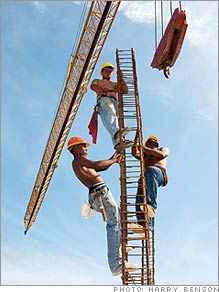
Construction workers on the Punta Pacifica construction site.

Call it Panamania. Is it a bubble in the making, or the rise of a new Miami? Despite the abundance of cranes around Panama City, only about 10 percent of the projects being sold are under construction, says McBride. "We're not even seeing the construction boom in Panama yet," he says. "This place will look like Manhattan if all these projects come to fruition."

Certainly the decision to spend $5.2 billion to double the width of the Panama Canal, the country's biggest source of revenue, is a sign of Panama's prosperity. The addition of a new lane and a new set of locks will allow post-Panamax container ships, the world's largest, to pass through the canal. "The expansion of the canal has woken up the curiosity of a lot of people," says Saul Faskha, the local developer of the Ice Tower and one of Panama's biggest boosters.

Panama's economy has been growing at breakneck speed - 8.1 percent last year, compared with 6.4 percent in 2005 - and the government finished the year with a surplus of $576 million. Exports from Panama's free-trade zone, the second largest in the world after Hong Kong's, have helped fuel the growth. The U.S. Congress is expected to sign a free-trade agreement with Panama sometime this year, which should boost exports even further. And several multinational corporations have moved or are moving their Latin American headquarters to Panama City, including Caterpillar, Sanofi-Aventis and Samsung.

Consumer spending has also swelled, the banking sector is strong, and 40,000 new jobs were created last year. All that is good news for the government of Martín Torrijos, son of former strongman Omar Torrijos, who ruled Panama from 1968 to 1981.

Unlike his father, the younger Torrijos came to power in a fair election in 2004. And unlike his father, Torrijos doesn't have to deal with a U.S.-occupied Canal Zone: Panama took control of the canal in 1999 and has proved adept at running it. Gone, too, are the U.S. troops that toppled another dictator, Manuel Noriega, a corrupt former general who is nearing the end of a 17-year U.S. prison term for cocaine trafficking.

Rumors that Noriega might want to return to Panama have cast a cloud over an otherwise bright mood. But the country, 36 percent of whose population lives in poverty, has other problems to deal with. For one thing, says Torrijos, during a recent trip to a small mountain town, "there is a huge demand now for a skilled workforce."

Indeed, a labor shortage has already helped slow construction activity in Panama City, and developers are concerned that other factors may hinder the completion of projects. Materials and equipment are in high demand, from rebar to cement to earthmovers. The construction frenzy has also put a strain on the city's infrastructure, and the government is struggling to build enough roads, water-treatment facilities and other projects.

One big problem: All of Panama City's sewage is dumped into the bay, and a treatment plant won't be completed until 2009. "Panama has grown very, very fast - we didn't anticipate this," says Ubaldino Real, Minister of the Presidency. "The government has had to take out more money to be able to act much faster to build roads."

But that hasn't dampened the enthusiasm of people like José Manuel Bern, director of sales and projects for Empresas Bern, one of Panama City's oldest and largest developers. The company's Bayfront Tower, completed in April, is among the first buildings designed for foreigners - distinct from those built for locals because they have balconies but no maid's rooms. Bern says that he sold nearly all the apartments in the tower four years ago, and that units that originally went for $130,000 now sell for $330,000. "We used to be very focused on the local market," he says, "but now I sell to a foreigner every other day."

Prima Panama's McBride and others are worried that the building boom is ultimately going to exceed demand. "I do not think there will be sufficient buyers to absorb capacity, if in fact capacity is delivered," McBride says. "When you see prices going up, driven by speculative investors, that points to a bubble."

Try telling that to Adolfo Olloqui, a Spanish developer whose company, Grupo Olloqui, is building what will be one of the tallest luxury towers in downtown Panama City, the 77-story Palacio de la Bahia. "Panama is the Miami of the future," he says. "With the visa problems in the U.S., South Americans, Central Americans and North Americans will want to come here to do business and to live."

Or try telling it to the Buckleys, who at least have a splendid view from their new Panama perch.

Pictures and more in http://money.cnn.com/magazines/fortune/fortune_archive/2007/07/09/100122336/index.htm

Thursday, June 07, 2007

Term of Tourist Visa reduced to 30 days

... or how to shoot the hen which lays the golden eggs...

Law 15 of 2007, entered into force upon its publication on May 25, 2007, which reduces the duration of Tourist Visas from 90 days, with a 90 day extension (originally in force since 1995), to 30 days with a 60 day extension. While European Union Schengen Treaty citizens are exempt from a visa requirement to enter and US citizens are sold a $5 "tourism card" as reciprocity visa upon entry, all foreigners are subject to this 30 day limit. The Immigration website has a list of the current visa requirements by country. http://migracion.gob.pa/eng/servicio.php?cont=paisvisa

The Law was submitted as Bill 292 of 2007 http://www.asamblea.gob.pa/buscador/2007/2007_P_292.pdf "whereby measures are enacted for the protection of citizen safety" by Olga Golcher, Minister of Government, in April 3, 2007. The Bill had measures to counter the rising power of juvenile gangs, and buried into the text was a new definition of Tourist Visas:

Artículo 36. El numeral 1 del artículo 1 del Decreto Ley 16 de 1960 queda así:
Artículo 1. Los extranjeros que ingresen al territorio nacional serán clasificados como
turistas, transeúntes, viajeros en tránsito, viajeros en tránsito directo, visitantes
temporales e inmigrantes:
1. Son turistas los que llegan con fines exclusivos de recreo u observación por un
lapso de treinta días, prorrogable hasta por sesenta días.


Over-zealousness at all levels

Obviously, nobody foresaw the effect this will have on residential tourism, since it takes more than 30 days to have a feel for the country, look at properties, purchase a home, and THEN decide to apply for a residence visa. The April 18 "Technical Report" made by legislative staffer Agapito González Gómez says that "the costs of the implementation of the bill will be compensated with the benefits that its special measures produce. However, given the provisional character of said measures, it would be convenient to take into consideration that all the costs of its application, in the end, may exceed the material benefits they may produce." Translation: We are worried about gang warfare and we have doubts about whether increased prosecutorial powers may have lasting benefits (forget about the tourism aspect).

The Technical Report recommended calling to committee hearings several government entities and child welfare instutions (UNICEF Panama, Alianza Ciudadana Pro Justicia, Pastoral Penitenciaria) and NGOs in general but flatly excluded the Panama Tourism Institute IPAT, Ministry of Commerce and did not identify real estate and tourism industyr associations. Eventually, Union Nacional de Abogadas, Asociacion Panama Verde, Consejo Nacional de Juventud, Creation Associates International and other child welfare and criminal law groups participated in the Committee hearings. The April 19 Minority Report by opposition legislator Jose Blandon only mentions "the lonely immigration provision" to criticize the PRD for not voting on an Immigration Bill submitted in 2004 (which also reduced the 90 day tourism term).

Only when the final Law was published in the official gazette as Law 15 of 2007 "whereby measures for the speeding of the prosecution in ordinary criminal procedures and special procedures for criminal liability of teenagers and other measures are enacted" (in Spanish "que dicta medidas para la agilización de la instrucción sumarial en los procesos penales ordinarios y en los especiales de responsabilidad penal de adolescentes, y otras disposiciones") and La Prensa http://www.prensa.com/hoy/panorama/997953.html printed the results of a press conference by the Immigration director did most of the non-criminal law community learn about the 30-day tourist visa.

3 days later, the Tourism Minister issued a press release announcing that "the project “Tourism, a reason to create business ventures and decrease poverty” was launched by Minister of Tourism Ruben Blades before hundreds of micro-entrepreneurs at the inaugural ceremony of the AMPYME National Meeting that took place at the ATLAPA Convention Center."http://www.ipat.gob.pa/eng/page.php?page=news&art=44 We presume that the 30 day limit will discourage those who may take longer than that to buy a property and thereby help businesses which reduce poverty. The Ministry has a "Contact Us" http://www.ipat.gob.pa/eng/page.php?page=contact_us page where comments can be sent.


More legal trivia

In the haste to approve the law (52 days), Article 3 of Law Decree 16 of 1960 on Immigration was left without alteration, which provides that
"tourism cards will be valid to remain in the country for ninety (90) days until completing one hundred and eighty (180) days".,
as well as Article 5 ("The Panamanian Consulates shall issue tourism cards valid for ninety (90) days, after paying five" balboas). Under Article 14 of the Civil Code ("Cuando las disposiciones tengan una misma especialidad o generalidad y se hallaren en un mismo Código, se preferirá la disposición consignada en el artículo posterior"), these 2 provisions prevail over the amendment to Article 1, so... tourist cards (not necessarily those tourist visas without a card) should be granted for 90 days...


The other side of Panama friendlyness

So what can a violator of the 30-day rule expect? Tourists exceeding their visa term are apprehended and taken to a small cell at the Immigration offices to determine their status. In the best case, their lawyer is allowed 24 hours to submit all papers for a visa where he/she can qualify for. In the worst case, it would be a weekend or evening, so the tourist is taken to the untouristy Directorate of Police Investigations (DIIP). Depending on the perception of how dangerous the tourist is, he/she will be held separately from the other violent criminals held for felonies from all over the city. It is not the Turkish Express, but certainly not a night at Waldorf. If the tourist does not qualify for any visa, he/she is deported and not allowed back into the country.

In the meantime, the government still refuses to demand visas from countries with high immigration rates, such as Colombia. Actual criminals will not be deterred and will continue using the shipping lanes into Colon and other routes to enter the country. A user-friendly system for granting of multiple-entry tourist visas for financially sound citizens of Dominican Republic, Venezuela and Colombia (just show passport, tax return and valid credit cards at the consulate to get the equivalent of B-1/B-2 US visa) is a necessity to bring investment into the country and discourage criminal elements.

Options when being close to the end of the 30-day period

So the legal alternatives when the 30-day term comes are:

1) Separate 2 mornings at Panama Immigration and file for a final 60-day extension form http://migracion.gob.pa/eng/documentacion/corregidos/prorroga_de_turista.pdf along with
a. Valid passport, tourist visa/card and 2 copies of its ID page and Panama entry stamp
b. Return airplane ticket valid for a flight in 60 days or more
c. Letter from Panamanian or legal resident who will sponsor and assume responsibility for the applicant, with copy of the signor's ID.
d. Proof of economic solvency of the applicant or the sponsor : tax return, credit card or bank reference letter showing more than $500 monthly available.
e. 3 passport-size pictures
f. Magazines and newspapers to read while you wait

2) File an appeal under Articles 3, 5 and 86 of Law Decree 16 of 1960,

3) Head to Costa Rica http://www.migracion.go.cr/visas/DirectricesvisasMayo2007.doc, where a tourist visa for US, European Union / Schengen and Central American citizens lasts 90 days Sounds brutal, but that is how tourists think and their pockets move.

Tuesday, May 08, 2007

High U.S. Government Officials to attend ExpoTrans in Panama


A delegation of high officials of the U.s. Government, lead by U.S. Secretary of Transportation Mary E. Peters, will travel to Panama on May 7-9 to attend ExpoTrans 2007, a transportation conference organized by the U.S-Panama Business Council

The conference will take place at the Miramar Intercontinental Hotel and will address topics related to maritime, aviation, land transportation and logistics. During the luncheon of May 7 the Council will present its “Friendship Awards” to Panama Canal Administrator Alberto Alemán Zubieta and on Tuesday evening, during its traditional “Friendship Awards Dinner”, will recognize the prestigious companies Copa Airlines and Panama Ports Company.

For additional information contact Enrique Sosa, Executive Director of USPA, at 269-2178, uspa @ cableonda.net


Panama mortgage loans for foreigners


One of the many questions we receive is what are the requirements for a mortgage loan. Each bank has their own list of requirements and not all cater to expats arriving to Panama. All banks ask that a bank account be opened with them as additional collateral, which in turns means that a new customer must provide all due diligence and know your customer documents.

We received this list from Credicorp Bank which responded to our survey:

A. Source of Funds Identification

This process is necessary to identify the source of funds and also to measure the large of the account. Basic documents are as follow:


1.Personal Accounts

  • Personal accounting balances

  • Personal Income Tax Declaration

  • Last two month personal bank account statement.

2.Corporation Accounts.

  • Copy of the Registration of the Corporation

  • Balance Statement of the corporation. Must be stamped/duly signed by an Authorized Accountant.

  • Last two month personal bank account statement.

B. References.

1.Personal Accounts

  • Personal Bank References

  • Personal Credit Office References (from a credit bureau office).

2.Corporation Accounts.

  • Corporation Bank References.

  • Commercial References of a Service Provider or important client.

  • Corporation Credit Office References (from a credit bureau office).

C.Copies and Other Documents.

1.Personal Accounts

  • Passport copy (copied in the bank premises.)

  • Driver License (copied in the bank premises)

  • Copy of a utility bill.

  • Fill out of internal account opening forms.

2.Corporation Accounts.

  • Copy of a utility bill.

  • Copy of product brochures, annual corporation book or any other important document related to the operations of the corporation.

  • Fill out of internal account opening forms.

D. Mortgage Loans.

1.Basic Documentation

  • Draft of Sale Contract.

  • Fill out internal forms.

  • Most recently-made appraisal (if required)

  • Copy of the Title (if required)

  • Opening of Bank Account (information above).

2.Basic Parameters (subject to negotiate)

  • Competitive Interest Rates

  • Term up to 30 yrs for personal and 15 yrs for commercial

  • Loan amount up to 70.0% of property value.

  • Life insurance of debtor for total amount of loan endorsed to the bank.

  • Fire Insurance for 80.0% of construction value per appraisal submitted endorsed to the bank.

  • 1.0% of FECI tax (if applicable)

  • Up to 1.0% of commission based on loan amount.

Their website has a handy online mortage calculator.
.

Friday, April 06, 2007

Panama Attorney Delivers Presentation Before Chamber of the Americas

Attorney Alvaro Aguilar delivered a presentation on Panama real estate laws before US investors with the 2007 VIP Real Estate Mission to Panama organized by the Denver-based Chamber of the Americas

Panama, Panama, April 03, 2007 --(PR.com)--
Lombardi, Aguilar & Garcia (http://www.laglex.com/) attorney Alvaro Aguilar delivered a presentation on Panama real estate laws for US investors, co-authored by Kevin Mullin of the Denver, CO, law firm of Mullin, Dean & Heimos, LLP (http://www.mdhlex.com/). The presentation was part of the 2007 VIP Real Estate Mission to Panama organized by the Chamber of the Americas (http://www.chamberoftheamericas.com/) & Continental Airlines. Real estate businessmen from Colorado and the rest of the US attended the event.

Mr Aguilar spoke about the procedure for acquiring title to property and financing a property purchase in Panama. While Panama is a booming real estate market attracting buyers from the U.S. and Europe, due diligence is necessary when purchasing rural properties. Current regulations offer tax incentives to property owners and builders and encourage foreign retirees to reside in Panama. Slides of the presentation may be downloaded from the law firm website.

Co-author Kevin J. Mullin, J.D., CPA, LL.M. (International Taxation), has been practicing law for over 20 years with a focus on advising foreign investors on their U.S. real estate and other investments, and international business, estate and tax planning. His law firm of Mullin, Dean & Heimos, LLP, focuses on international tax, real estate and business, including foreign persons investing in the US and US persons investing abroad, especially in Latin America. Its specialties include U.S. and foreign real estate and closely-held businesses; multi-jurisdiction estate planning and wealth preservation; cross-border joint ventures, global licensing of intellectual property, including e-commerce; and shari'a compliant instruments. Both law firms work together on an on-going basis to provide guidance to US clients from both the US and Panamanian tax, real estate and business perspectives.


Full text in http://www.pr.com/press-release/34166
RSS Feeds: