Friday, June 26, 2015

European Commission issues "black list" of 30 "tax havens"


Action Plan on Corporate Taxation

On 17 June 2015, the Commission adopted an Action Planpdf Choose translations of the previous link for fair and efficient corporate taxation in the EU.
The Action Plan sets to reform the corporate tax framework in the EU, in order to tackle tax abuse, ensure sustainable revenues and support a better business environment in the Single Market.
See the timelinepdf. 

5 Key Areas for Action have been identified:

1. Re-launching the Common Consolidated Corporate Tax Base (CCCTB)
2. Ensuring fair taxation where profits are generated
3. Creating a better business environment
4. Increasing transparency
5. Improving EU coordination 
A map of non-cooperative tax jurisdictions has also been published, in a move to reinforce the EU's response to external threats to Member States' tax bases.
The Commission also adopted a decision to prolong the Platform on Tax Good Governance, and revise its scope and working methods.
For further information


The map was drawn up on the basis of work done by the Platform for Tax Good Governance and the information provided by EU Member States.

Top 30 listed countries: Andorra, Liechtenstein, Guernsey, Monaco, Mauritius, Liberia, Seychelles, Brunei, Hong Kong, Maldives, Cook Islands, Nauru, Niue, Marshall Islands, Vanuatu, Anguilla, Antigua and Barbuda, Bahamas, Barbados, Belize, Bermuda, British Virgin Islands, Cayman Islands, Grenada, Montserrat, Panama, St Vincent and the Grenadines, St Kitts and Nevis, Turks and Caicos, US Virgin Islands.

Panama is listed by Bulgaria, Croatia, Estonia, Greece, Italy, Latvia, Lithuania, Poland, Portugal, Slovenia, and Spain.

Full text in the European Commission website http://ec.europa.eu/


Monday, April 06, 2015

Lombardi Aguilar Group partner to moderate a panel at AmCham Trade & Investment Forum


Abril 8 Foro AMCHAM
Trade and Investment Forum

Attorney Alvaro Aguilar will be moderating a panel on anti-counterfeiting measures at the AmCham Trade & Investment Forum


PRLog - April 5, 2015 - PANAMA CITY, Panama -- On Wednesday, April 8, Lombardi Aguilar Group (www.laglex.com) partner Alvaro Aguilar-Alfu will be moderating a panel at the American Chamber of Commerce & Industry of Panama (AmCham Panama) Trade & Investment Forum on  "Challenges and Realities of the Fight Against Illicit Trade". Aguilar will moderate a panel discussing the effects of illicit trade on the pharmaceutical and health industries.

The forum will have panels and exhibits from:

- Representatives Intelectual Property Registry (DIGERPI), Judicial Investigation Directorate (DIJ), Intellectual Property Attorney General and other government agencies engaged in fighting illegal trade,

- Representatives of multinational corporations and local businesses affected by illicit trade,
- Business Alliance for Secure Commerce (BASC) and local Food & Drug Administration (FDA) representatives.
- The Director of the Global Intellectual Property Center (GIPC) of the US Chamber of Commerce.

"The best known forms of illegal trade include manufacturing of counterfeit clothes, shoes, watches, audiovisual media (discs, movies, games)", Aguilar said. "The offering to the public of counterfeit versions of products which failure can cause accidents - such as auto parts, software, and other construction products - should cause concern. In the most dramatic cases, products for human consumption such as food, drugs and cigarettes are regularly altered or forged. The geographical position of Panama and logistical advantages are exploited by the merchants of illicit trade for transferring products to the Americas and other continents."

Mr. Aguilar is a graduate of Universidad Santa Maria la Antigua (LLB) and Washington College of Law at The American University (LLM). He has 20 years of experience in intellectual property protection and litigation on behalf of local, European and U.S. companies doing business in Latin America.  Mr. Aguilar also serves as Chairman of the AmCham Panama Trade & Investment Committee, which provides a friendly forum for information exchange and collaboration between the public and private sector, strengthening relationships with key groups of stakeholders in the region, including the National Government, embassies and other private-sector organizations.

The forum and luncheon will be held at Sortis Hotel in Panama City from 8 am to 2 pm.  Those interested in attending this event can register through the AmCham website at:http://www.panamcham.com/es/events/upcoming-events/cal Tel. 301-3881.

About The American Chamber of Commerce & Industry of Panama (AmCham Panama)

Founded in 1979, AMCHAM Panama http://www.panamcham.com is a non-profit, non-political, independent, voluntary association supported primarily by its members.  Much of the organization's work is accomplished through the efforts of volunteer member committees which collaborate to help AMCHAM promote free enterprise in Panama. AmCham Panama has over 450 active members, from small local companies to major multinational companies based in the United States.

About Lombardi Aguilar Group (LAG)

Lombardi Aguilar Group is a partnership of consultants created as an alternative for clients worldwide who seek fast, innovative and effective solutions to their legal problems. The firm currently provides services to individual and corporate clients in Panama as well in the Americas, Europe and Asia. Its partners maintain a commitment with professional ethics and social responsibility by participating in the board of directors of groups such as the Panama Bar Association, the Alliance Francaise, the German and the American Chambers of Commerce (AMCHAM) of Panama, and the Association of Chinese-Panamanian Professionals (APROCHIPA).

The firm centers its law practice in private client services and asset protection (Private Interest Foundations, Trusts), business structures (Offshore Corporations), tax planning, real estate and e-commerce. It also advices in areas of Law such as Corporate, Commercial, Intellectual Property, Maritime, Tax, Environmental, Life Sciences and Immigration Law as well as related litigation.

For more information, contact +507 3406444, e-mail info (at) laglex.com, or see: Lombardi Aguilar Group http://www.laglawyers.com

See full text in http://www.prlog.org/12442772-lombardi-aguilar-group-partner-to-moderate-panel-at-amcham-trade-investment-forum.html


Panama moves to boost power generation

Efforts to meet rising demand for power in Panama took a key step forward in January, with news that state-owned Empresa de Transmisión Eléctrica (ETESA) would be seeking bids to supply 700 MW of thermal energy.
The tenders form part of a broader move to diversify the energy mix and boost capacity in one of Latin America’s fastest-growing economies with ambitious investment plans – from both public and private sources – being rolled out across the utility spectrum. Panama plans to make available two separate contracts, each for the supply of 350 MW of thermal energy. Contractors will be given 90 days to prepare bids for the first project – a 10-year contract commencing July 2017 – while a deadline of 180 days has been set for a second, 15-year contract, scheduled for launch in January 2019.
ETESA’s general manager, Iván Barría, said that with interest among industry players high, he was confident competition around pricing for the projects would be aggressive. Barría also explained Panama’s shift in focus towards thermal energy, saying: “...we have hard energy needs, having contracted significant renewable energy in the past: now we need to complement that.”

Boosting capacity

In a separate development, the World Bank’s financing arm, the IFC, announced in January that a $300m financing package for constructing the second and third phases of the Penonome wind farm project had been finalised. Once completed, the project will offer 215 MW of installed capacity, making it the largest grid-connected wind farm in Central America. The wind farm, which will house 86 turbines, is expected to generate around 448 GWh of energy annually, equivalent to about 5% of total electricity demand.
Panama is also looking to boost the role of hydroelectric power in meeting rising demand for electricity. Its $1bn Chan II hydroelectric project, earmarked for the western province of Bocas del Toro, will add around 214 MW of capacity once operational, which is expected to provide up to 9% of total demand.
The country is currently struggling to keep up with soaring demand for power. Electricity consumption is expected to grow at around 8% annually, according to government forecasts, with the cost of putting in place the additional power-generating capacity required to meet demand over the next decade estimated at around $3bn. More than a third of the country’s electricity comes from burning fossil fuels, which, until the recent slump in oil prices, have been costly, and bring environmental risks.

Harnessing the elements

While Panama’s hydroelectric plants, which account for around half of total supply, provide cleaner, renewable energy, they remain vulnerable to the effects of the dry season.
The risks of the large share of water in the energy mix were highlighted at the start of 2013 when, due to a prolonged summer, reservoir water had fallen to such low levels that generation capacity was being compromised at the same time that peak demand reached a record 1445 MW. As a result, the government implemented emergency measures to reduce national energy consumption, particularly in the month of May when the water levels reached one of their lowest points in history.
However, the dry season is also traditionally marked by stronger winds, which Panama is keen to harness through its Penonome project, as a means of offsetting the drop in hydro capacity. The Penonome wind farm initiative is operated by a subsidiary of regional player InterEnergy Holdings, while construction of the Chan II dam was awarded to Brazilian civil engineering company Odebrecht. Work is expected to begin in December and Panama hopes to start generating electricity at the site in 2019.

Addressing the challenges

However, there are concerns that the project could run into opposition from local communities. The site lies to the west of lands occupied by the Ngobe Bugle indigenous community, which has protested against mining and hydro projects there. Protests have also been held over the Barro Blanco hydro project to the south in Chiriquí province.
Panama additionally faces challenges at the opposite end of the power chain. Distribution companies Ensa and Gas Natural Fenosa have both highlighted the problem of electricity theft, with combined costs to the two players over the past five years estimated at the equivalent of $125m. Ensa put its losses from theft at $80m, while Gas Natural Fenosa’s manager, Vivian Pineda, said the firm believed the number of households in Panama stealing electricity stood at around 40,000, costing the provider some $45m.
Broadening the energy mix will certainly strengthen Panama’s efforts to keep pace with rising demand for power and support economic growth. However, rumblings of discontent among local communities, alongside concerns about electricity theft, highlight the importance of carefully managing the sector’s development.
 
Full text in http://www.oxfordbusinessgroup.com/news/panam%C3%A1-busca-elevar-su-generaci%C3%B3n-de-energ%C3%ADa?utm_source=Oxford+Business+Group&utm_medium=email&utm_campaign=5373099_EU+-+Panama+-+19%2f02%2f2015+-+Panam%c3%a1+busca+elevar+su+generaci%c3%b3n+de+energ%c3%ada&utm_content=Panama-EU-19%2f02%2f15&dm_i=1P7V,375WR,HYTLQE,BGEP9,1#”english”


Monday, March 02, 2015

Moving along: Continuing to expand the Panama transport and logistics network

 
A geostrategic location and the presence of the Panama Canal make Panama a natural centre for transportation and logistics. In fact, the transportation, logistics and communication sector combined is easily the largest contributor to GDP, a fact recognised by the current administration. In its Strategic Economic Plan 2010-14, the logistics sector, along with finance, agriculture and tourism, was identified as one of the country’s four pillars of economic growth. To secure the future of the sector the administration is investing $9.6bn, equivalent to 70% of public sector investment, from 2010 to 2014 in infrastructure upgrades alone. Public spending on infrastructure extends well beyond the flagship $5.25bn Panama Canal Expansion and includes the construction of a line on the Panama City Metro, a large overhaul of the national road network and several upgrades to maritime and airport infrastructure. With the canal’s ability to attract global trade, the country has been working for nearly a decade to create a business-friendly regulatory framework – replete with special economic areas and incentives for multinational headquarters – which should serve in attracting further investment as it continues developing the transport and logistics hub. While on the one hand the government is moving quickly to ensure its infrastructure networks are capable of providing a platform for the growing logistics and value-added manufacturing industries, on the other it is aggressively revamping airport infrastructure and further pushing to establish itself as a major aviation centre.

Quantifying Progress

Figures published by the National Statistics Agency (Instituto Nacional De Estadí stica y Censo, INEC) aptly portray the sector’s wider role within the rapidly growing economy. According to the latest available figures from INEC at the time of writing, the transportation and communication sector accounted for 24.1% of the nation’s total GDP (at 1996 prices) in 2012. Moreover, the sector has grown at double-digit rates in each of the past five years apart from 2009 when the global financial crisis slowed progress in the sector to 8.2%. The sector’s average annual growth rate from 2008 to 2012 was an impressive 12.7%. It has also been a major attractor of foreign direct investment (FDI) as logistics, construction and infrastructure firms look to take advantage of the country’s expanding role in regional and global transport. FDI stock in the transportation, logistics and communication sector reached $4.52bn in 2011 and represented 19.6% of the national total of $23.1bn, according to data from the National Comptroller.

Global Rankings

Heavy spending on infrastructure development has yielded improved scores in the World Economic Forum’s “Global Competitiveness Report 2013-14”. Indeed, Panama’s score in the report’s metric on overall quality of infrastructure has improved drastically under the current administration from 67th in the 2009-10 iteration of the report to 30th in the 2013-14 edition. Other related categories also paint a similar picture. Panama improved from 54th in the 2009-10 index to 35th in 2013-14 in goods market efficiency, from 18th to sixth in quality of port infrastructure, from 32nd to fifth in air transport infrastructure, from 62nd to 30th in railroad infrastructure, and from 62nd to 48th in road infrastructure.

Sector Structure

Despite steadily improving infrastructure across the country, the transportation and logistics sector lacks a titular head in the form of a dedicated Ministry of Transportation and Logistics. In its place is the Ministry of Public Works (Ministerio de Obras Públicas, MOP) which oversees the construction and maintenance of the national public infrastructure network, though in practice the MOP is primarily responsible for the national road network together with the autonomous Terrestrial Transport and Transit Authority. Numerous additional public entities with varying degrees of autonomy oversee the rest of the sector, including the Metro de Panamá Secretariat, a special secretariat created in 2009 to monitor the planning, construction and administration of the Panama City Metro. The Panama Canal Authority (Autoridad del Canal de Panamá, ACP) has been in complete control of the Panama Canal and its finances since the country took over control in 1999. Although it possesses a board consisting of various ministerial heads, another autonomous government agency, the Panama Maritime Authority (Autoridad Marítima de Panamá, AMP) is charged with overseeing all things maritime. Meanwhile, in the aviation sector it is the Civil Aviation Authority (Autoridad Aeronáutica Civil, AAC), which also boasts a diverse board full of governmental leaders, that supervises the country’s aeronautical activity.
In October 2010 the Ministry of Industry and Commerce (Ministerio de Comercio e Industrias, MICI), together with the Georgia Tech Panama Logistics Innovation and Research Centre, launched the National Logistics Council (Consejo Nacional de Logística, CNL). The CNL was created to establish a platform for collaboration among the government, private sector and academic institutions and eventually facilitate the development of the country into “the logistics and trade hub of the Americas”. However, the lack of a governmental ministry or secretariat charged with overseeing the long-term development of all infrastructures and responsible for coordinating inter-agency stratagem and budgets is a common complaint from the private sector given the already large and growing impact of the sector on the wider economy. Indeed, though the creation of the CNL represents a step forward in the logistics segment, it still falls short of the sort of authority granted the Secretary of Science, Technology and Information, for example, in driving the growth of the information and communication sector.

Legislation

The legislative environment in Panama has for the most part been conducive to business and investment in the country. Legal and tax incentives have been established through several laws for companies basing themselves in one of the country’s free or special economic and trade zones.
The Colón Free Zone (CFZ), the second-largest of its kind in the world, is a strong example of the importance of creating such areas, in particular for logistic and reexport companies. New special economic areas including Panama Pacifico and the City of Knowledge have also been created and should lead the way forward in the future (see Economy chapter).
However, in the second quarter of 2012 a new piece of legislation passed through the national legislature and was signed by the president. Known as Act 41, the legislation could cause issues with international investors within the maritime sector. The law stipulates that 75% of shares and personnel within the maritime services and auxiliary fuel distribution sector be sourced domestically. The rule sparked backlash from the EU, which considers it to be in violation of international commitments already made by Panama.

The Hub & Spoke

Panama’s location bodes well not only for its status as a trading hub, but also for its growing stature as a major regional centre of aviation. Indeed, Panama City’s location is within “narrow-body” range, the typical distance that the single-aisle airplanes which dominate the Latin American market can travel, of nearly all major cities within the Americas. Additionally, its improving airport infrastructure, expanding tourism sector and rapid economic growth are all supporting the country’s efforts to become the most important transit hub in the region.

Commercial Aviation

The impressive growth of Panama’s only major airline, Copa Airlines, also points towards a bright future for the sector. Founded in 1947, the Compañía Panameña de Aviación (Copa) is now the flagship airline of the country and one of the most prominent airlines in the expanding, yet still underserved, Latin America region.
Following the 2005 purchase of AeroRepublica in Colombia and the company’s initial public offering on the New York Stock Exchange, making Copa the third Latin American airline to list on the exchange, growth has been impressive. According to figures from Copa, from 2005 to 2013 capacity has increased at a compound annual growth rate (CAGR) of 17%, while earnings have experienced a CAGR of 21% during the same timeframe. As a result Copa has become one of the most profitable airlines on the planet, recording an operating profit margin of 17.9% for 2012. According to the latest data from the International Air Transport Association’s 2010 airline profitability report, the carrier ranked 10th in 2007 and fourth in 2008, with operating profit margins around 18-20%.
Meanwhile, the airline’s expansion plans include increasing its numbers in terms of fleet, route and frequency over the next five years. Indeed, Copa’s fleet plan includes the addition of 44 (30 firm orders and 14 optional) new aircraft between 2013 and 2018, most of which are single-aisle Boeing 737-800s with a range of 3000 nautical miles.

International Connections

Although Copa is responsible for more than 80% of daily operations at Tocumen International Airport, several international airlines also operate out of Tocumen including KLM, United Airlines, American Airlines, Iberia and Delta Airlines. In total, commercial airlines flying from Panama City service around 70 destinations – up from 29 in 2004.
The AAC has been working together with the Ministry of Foreign Relations and the executive branch to firm up accords with foreign nations over air traffic rights. According to Ivan Vergara, director of air transport at the AAC, “Over the past several years we have signed agreements with Brazil, Ecuador and Peru and expanded our accord with Mexico. In 2013 we also added or expanded agreements with Costa Rica and France as well.” Indeed, with Air France joining KLM and Iberia in operating transatlantic flights to Europe in November of 2013, Panama City could soon establish itself as a transit hub not only for travellers going from South America to North America, but to Europe as well.

Metro

One of the flagship projects of President Ricardo Martinelli’s administration, the construction of the $1.88bn Metro de Panamá should help to alleviate traffic congestion within the capital. The first line is expected to be inaugurated on March 5, 2014. The long-term master plan for the system’s development calls for the construction of four separate lines and one tramway line by 2035, though thus far construction has been started only on the first line (see analysis).

Urban Transport

In fact, the metro is just one part of a complete renovation of Panama City’s transportation system as the MOP has been in the midst of a major overhaul to the capital city’s road network since 2011. Meanwhile, structural changes to the existing public transportation system – mainly the replacement of the city’s diablo rojo (red devil) bus network – should also ease congestion in the medium to long term.
Over the course of the past few years numerous projects to improve road connectivity and traffic flow have seen various parts of Panama City turned into construction zones. In total the MOP reported in June 2013 that a combined eight road projects totalling $1.7bn were under way in the capital city. The largest project is the $782m construction of an underground connection between Avenida Balboa and Avenida Los Poetas, which was awarded to Brazil’s Odebrecht. It not only involves the construction of a new tunnel, but also renovations to Los Poetas, the construction of new sports facilities, bike lanes, gardens and even a sporting arena, the Maracanã Stadium. However, the project has become a source of controversy as it will also include the extension of the Cinta Costera (Coastal Beltway), a highway constructed a few years ago to relieve congestion inside the city and whose extension will wrap around the city’s Casco Viejo (Historic District).
While the project includes green areas and pedestrian walks it has drawn criticism as the beltway is seen as an eye sore and counterproductive to ongoing efforts to renovate the historic district. Fears that it would lead to the removal of Casco Viejo from UNESCO’s list of World Heritage Sites – due to the destruction of the centuries-old sea wall to make way for the highway – have been allayed as UNESCO announced in June 2013 the project would not impact Casco Viejo’s status.
The preservation of the historic district itself is a $175m project also being completed by Odebrecht and is seen as a key part of the country’s tourism development plan. Apart from renovating the area’s small streets and alleyways, the project also includes the construction of a new road dubbed Vía Cincuentenario. Both projects are expected to be completed in 2014.
Other projects include the $237m improvement and expansion of Avenida Domingo Díaz, which consists of the construction of three vehicular and three pedestrian bridges and the expansion of the road to six lanes.
Via Brasil, another major artery, is also being renovated in a two-phase project to the tune of $217m and $181m for each respective phase. The remainder of the investment, $76.5m, was poured into the construction of three underpasses, which are now fully operational.

On The Road

Outside Panama City, the road network is also under development as connectivity in the interior of the country continually improves. From 2009 to 2013 the MOP reported investing $3.4bn in road and public infrastructure projects, though the majority of that figure ($2.25bn) has been used to overhaul Panama City’s road network. Outside the capital the heaviest investment was found in Chiriquí, which received $262m, most of which was used to upgrade two highways from David to Boquete ($119m) and from Paso Canoas to Port Armuelles ($114m). Meanwhile, Veraguas received $179m; Herrera and Los Santos, each $156m; Coclé, $136m; Bocas del Toro, $72m; Colón, $64m; Comarca, $66m; and Darién, $61m.
In 2012 the introduction of a new stretch of highway from Panama City to Colón – easily the most important intra-city highway in Panama – reduced travel time from the capital to the Colón Free Zone to just 45 minutes. The project began in 2010, and when construction was completed in 2012, investment in the project reached $186m, MOP figures show. The $80.7m renovation of the Bridge of the Americas – which spans the Pacific entrance to the Panama Canal – is another major project which was started in 2010, though it will not be completed until the end of 2014.

Maritime Transport

Obviously many of the maritime transport activities revolve around the Panama Canal, which has extensive port facilities at both entrances in the Port of Cristóbal (Atlantic), the Manzanillo International Container Terminal (MIT, Atlantic), the Colón Container Terminal (Atlantic) and the Port of Balboa (Pacific). In total Panama boasts 14 private and 14 state-owned and operated ports. Ensuring the country is able to meet demand increases following the arrival of post-Panamax ships after the completion of the Panama Canal expansion project is crucial to sustaining the long-term growth of the sector.
“Panama needs to have more terminals built in order to continue growing, especially a new post-Panamax port inside the canal,” Ricardo Lince Boyd, the executive president of Agencias Continental, a local ports and shipping logistics firm, told OBG.
Both the Port of Cristobal and the Port of Balboa are receiving an upgrade by the Panama Ports Company, operator of both ports, at a cost of $1bn. All expansion projects at both ports are expected to be completed by 2015 and will improve their combined capacity to 6.5m twenty-foot equivalent units (TEUs).
Meanwhile, the MIT and the Colón Container Terminal (CCT) serve the CFZ and have also received sizeable investments in recent years. According to information published by Georgia Tech, the CCT recently spent $100m upgrading its terminal to its current capacity of 1.3m TEUs. The MIT is currently investing $270m to upgrade capacity to a total of 4m TEUs per year.

Logistics

Identified as one of the four pillars of future economic growth, the logistics sector is arguably the most integral piece in further developing the Panamanian economy. According to Proinvex, the investment promotion agency, roughly 3% of global maritime trade, including 10% of US international seaborne trade, passed through the canal in 2013. These figures are likely to swell upon the doubling of the canal’s cargo capacity once the expansion project is complete. This fact alone gives the country an edge over competing logistics centres in the Caribbean and along the Atlantic coasts of the US and South America. Still, obstacles do stand in the way, mainly a lack of qualified personnel.

Outlook

All of the ingredients for Panama to become a centre for transportation and logistics are beginning to coalesce. Domestic connectivity is being upgraded via major infrastructure projects such as the Metro de Panamá, the Panama-Colón Highway and an overhaul of the national road system. Meanwhile, international connectivity is also being improved thanks to continued investment in airports and seaports. Nevertheless, if the goal of improving national transportation infrastructure is to capitalise on goods moving through the canal by expanding the logistics and transport sectors, there are still obstacles to overcome such as the short supply of labour and strong regional competition.
 
Full text in http://www.oxfordbusinessgroup.com/overview/moving-along-continuing-expand-transport-and-logistics-network


Tuesday, February 10, 2015

15 Panama banks under inspections by the Superintendent

The investigation on alleged corruption by former officials of the previous administration has resulted in doubts about the enforcement of Politically-Exposed Persons (PEP) KYC rules by local banks, since several of those officials were signatories of companies receiving funds from possible kickbacks.  The KYC procedures of 15 banks are subject to inspection.


Date: January 29, 2015
SUPERINTENDENCY OF BANKS OF PANAMA
COMMUNIQUÉ
Following up on the information in Circular SBP-DR-0152-2014, released on November 26, 2014 and sent to all regulators, the Superintendency started a special examinations program on all banks in the market, aimed at verifying compliance with the regime established to prevent their services from being misused for money laundering, the financing of terrorism and related crimes, or crimes of a similar nature or origin. This program is in addition to the examinations conducted by the Superintendency.
The special examinations program is currently being exercised in fifteen (15) banks of the System. To date, five (5) of these inspections have been concluded, five (5) are being finalized and five (5) will be started shortly.
The Superintendency has pressed charges for allegedly failing to comply with the provisions of the Banking Law, Law 42 of 2000 and Rule 12-2005 on two (2) of the five (5) banks whose inspections have been completed. The files on the other three (3) are under assessment to determine charges. At the same time, the rest of the examinations being conducted could also end in administrative processes against these banks.
It is worth emphasizing that the concluded and ongoing administrative processes, as well as those that will be conducted later on must comply with the due process and secrecy required by our country’s laws.
We reiterate that the Superintendency of Banks will apply the sanctions provided for in the Banking Law and Law 42 of 2000 in those cases where noncompliance with the legal and regulatory frameworks for the prevention of money laundering and the financing of terrorism and of the banking regime is proven. To illustrate, failure to comply with the provisions on the prevention of money laundering and the financing of terrorism can incur fines of up to B/.1 million and breaches of other Banking Law provisions can incur fines of up to B/.500,000, depending on the seriousness of the breach, recidivism, the extent of the damage and the harm caused. 
These penalties will be applied without prejudice to those established by other competent authorities.
It is also important to clarify that according to the provisions in the Banking Law, any information on individual clients of banks obtained by the Superintendency while discharging its duties must be maintained under strict confidentiality and would only be disclosed when required by competent authority in accordance with legal provisions during a criminal proceeding.
Alberto Diamond R.
Superintendent
January 28, 2015

http://www.superbancos.gob.pa/documentos_ing/laws_regulations/notice/2015/notice_3-2015.pdf

Monday, January 05, 2015

Baru Free Trade Zone offers tax savings in Western Panama


BARU FREE TRADE ZONE (BFZ)


Located in the Baru district, on the Pacific side of Chiriqui province, Baru Free Trade Zone was created by Law No. 19 of 2001 with the purpose of establishing a special tax and customs regime to promote tourism, a logistic multimodal system, export processing zones and petroleum development area. Baru has an area of 588.7 sq. km. and population of 60,551 inhabitants. The zone is divided in 5 small villages, which are eager to develop the economic potential of the area. Baru FTZ meets the requirements to be a dynamic place for business, based on the following features:


  • Commercial Zone: It is expected to become an important platform for agricultural exports since Chiriqui Province is rich in agricultural production. It enjoys an easy access to ports on the Pacific side, and therefore, enables it to export goods to the whole continent, Europe and Asia, as well as to new markets. It is seen in the future as a regional warehouse and distribution center for all sorts of merchandise. There are duty free shops in the border area of Paso Canoas and Puerto Armuelles, where you can find commodities such as liquors, perfumes, electric appliances, car devices, and so forth.
  • Tourism Development Zone: Plenty of virgin natural resources and convenient access ways, Baru provides the opportunity to launch any kind of ecological adventure, while offering interesting and picturesque sightseeing such as Paso Canoas International village, near the border with Costa Rica, in which you can find a multiple variety of shops and commercial establishments. The multicultural nature of Baru adds special charm for visitors. The company Fish on Panama, Inc. has already invested more than US$ 500,000 in developing sports fishing activities. There are incentives to promote tourism development which allow to import free of tax ships, yachts, airplanes and any other vehicle that will be required to develop such activities. Furthermore, companies that invest in the tourism zone will be exempted from the income tax and can receive other fiscal benefits.
  • Manufacturing Zone: Baru aims at transforming itself into a manufacture and re-exports zone of agricultural products. Its main objective is to guarantee regular supply of perishable agricultural products to markets in Europe, US, Canada and Asia. It also seeks to boost a regional economic cooperation framework in areas such as transport, classification, management, packaging design, freight handling and warehousing techniques and so forth. For instance, wood manufacturing and exporting firm Tecno Empresarial, S.A. has made an important impact to the region, where it has invested above US$ 1.5 millions. Based on the zone regulations, companies could be exempted from income tax, import tax on equipment and machinery, and be subject to any other benefits for being involved in activities related to manufacture.
  • Petroleum Zone: Baru Free Trade Zone is able to store, manufacture, refine, purify, blend, market, transship, transport, pump, process, transform, sell, export, re-export, provide and in general sense, operate and handle crude, semi-crude and any other oil related products. A 204 km-long roadways in the region, and a 131 km-long oil pipeline crosses the Isthmus from the Pacific to the Caribbean Ocean, by which oil from Ecuador is transported to the terminals located in Panama, such as Charco Azul, which allows oil tankers of 300,000 dwt to dock.


INCENTIVES AT BFZ


  • A special and simplified procedure for the establishment and operation of a manufacture zone to export, which enables the creation of large factories to export a huge variety of goods.
  • Exemption of payment of the Panama income tax, patents, licenses and tax on other goods or capital.
  • Exemption of the import tax of raw or semi-elaborated materials, construction materials, equipment, furniture, accessories, appliance, or services that will be used in the operation of the company.
  • Exemption of the consumption or sales tax (ITBM)
  • Exemption of tax on interests, bonds and stocks.
  • Exemption of exports tax.
  • Issuance of one-year-valid resident business visa to perform transactions or business, which is also applicable on equal terms to spouse and children of the applicant.
  • Use of multiple reentry permit until visa expiration date.

Facilities & Advantages

Baru Free Trade Zone has the following facilities to offer:

  • Infrastructure: Airport, docks, paved highways, the second transcontinental oil pipeline built in the Americas.
  • Public utilities such as electricity, telephone lines and drinking water.
  • Adequate land features for the construction of deep ports.
  • Flat and fertile lands.
  • Extended beaches for tourism development.
  • Abundant fauna and flora.

HOW TO ESTABLISH BUSINESS AT BFZ?

Requirements

  • Power of Attorney addressed to the General Manager of the Baru Free Zone, requesting company registration.
  • Notarized copy of the company’s Article of Incorporation.
  • Four-month valid Certificate of Public Register of the company.
  • Copy of the petitioner’s Lease Agreement requesting the Permit for Operation.
  • Valid Certificate of Tax Payment.
  • Completely fill out the form ZFB-05 on Permit for Operation Application.
  • Copy of personal ID or passport of the Legal representative as well as the Manager of the company.
  • Letter of Commercial References.
  • Letter of Banking References
  • Form ZFB-09 related to the Income Statement of the company’s legal representative.
  • Form ZFB-10 related to the Income Statement of the company’s manager.
  • Certificate of Tax Payments of Baru Free Zone. Fees for Operation Permits (US$ 1,200, annually) and Operation Code Fee (US$ 200, annually).
Sources:

Monday, December 15, 2014

деоффшоризации


Практические примеры наиболее эффективных корпоративных структур для оптимизации бизнеса и налогообложения для предпринимателей из России и стран СНГ (с учетом деофшоризации)

Здравствуйте, уважаемые читатели бизнес-портала Offshorewealth.info о современных корпоративных решениях для международного бизнеса и защиты личных капиталов бизнесменов и инвесторов!
Комплекс мер по «деоффшоризации», предпринятый российским правительством в этом году (и, в первую очередь, недавние поправки в Налоговый кодекс) демонстрируют необходимость более четко обосновывать наличие в структуре бизнеса компаний, зарегистрированных в низконалоговых юрисдикциях. Государство выступает, главным образом, против ухода бизнеса от налогообложения в РФ, и в этой связи важно продемонстрировать, что снижение налоговой нагрузки не является приоритетной целью использования иностранных компаний для ведения предпринимательской деятельности.
Таким образом, главной особенностью развития оффшорной индустрии в наши дни является движение от налоговой эффективности (оптимизации по одному параметру) к оптимизации бизнеса в широком смысле, то есть улучшению предлагаемых бизнес-моделей по ряду параметров. В данной статье мы приведем ряд примеров таких современных решений, которые будут эффективно работать в эпоху пост-деофшоризации.
Статья написана по материалам презентации, которую Сергей Богатырев, ведущий эксперт Offshorewealth.info, сделал на конференции Интакс в Москве в сентябре 2014 года.
...
И, наконец, последний из наших примеров для данной публикации.
Иностранный инвестор вкладывает 10 миллионов долларов США в инфраструктурный проект в Казахстане. Доходы по проекту поступают из Казахстана в виде дивидендов.

Как известно, при выплате дивидендов из Казахстана источник выплаты удерживает налог по ставке 15%.
Оптимизировать налогообложение в данном случае можно следующим образом: владельцем компании в Казахстане является сингапурская компания №1. Акционером сингапурской компании №1 также является сингапурская компания (присвоим ей номер 2). Компания №1 является владельцем актива (долей в казахстанском предприятии), следовательно при продаже актива именно она будет выступать продавцом и контрагентом инвестора-покупателя. И если покупателем выступает институциональный инвестор, у него могут пожелания не только по стране регистрации контрагента (компания №1), но и его акционера (компания №2). Выбор сингапурских компаний дает следующие преимущества:
  • Сингапур - респектабельная юрисдикция с проработанным законодательством;
  • Идеальный имидж, который может быть важен для стратегических институциональных инвесторов и инвесторов с государственным участием (при продаже доли будут продаваться доли сингапурской компании и продавцом будет выступать сингапурская компания, что обеспечивает отсутствие претензий к «чистоте» бизнеса со стороны государства);
  • При выплате дивидендов из Казахстана удерживается налог по ставке 5%;
  • В Сингапуре можно получить освобождение от уплаты налогов;
  • Выплата дивидендов из Сингапура не облагается налогом у источника.
Акционером компании №2 является компания, зарегистрированная в Невисе, которой владеет панамский частный фонд.
Таким образом, прибыль по проекту аккумулируется в низконалоговых юрисдикциях с высоким уровнем конфиденциальности и приемлемыми затратами на содержание компаний.
Главный вывод из приведенных примеров состоит в том, что применение корпоративных структур с участием иностранных компаний возможно даже в условиях деоффшоризации.
В этих новых структурах находится место как оптимальным в данный момент классическим оффшорам (Невис,Панама и т.д.), так и юрисдикциям, набирающим популярность в последнее время (Сингапур).
Наши специалисты с удовольствием ответят на возникшие у Вас вопросы и смогут создать для Вашего бизнеса структуру, которая будет эффективной с учетом всех современных тенденций и требований).
Offshorewealthinfo


Monday, December 01, 2014

U.S. Chamber points out problems with FATCA website


The Next Obamacare? FATCA Roll Out Flounders

Thursday, January 9, 2014 - 8:45am — Written by David Kinkade

Website Woes Raise Concerns
The Internal Revenue Service (IRS), which is responsible for the law’s implementation and enforcement, has faced serious technological difficulties in launching the FATCA online registration portal, where foreign financial institutions are required to register and report information on their account holders. The IRS estimates that between 200,000 and 400,000 financial institutions will register.
The initial Foreign Financial Institution Registration System (FRS) was developed and near deployment in 2012 at a cost of $8.6 million—then summarily terminated in November 2012 due to regulatory changes and policy issues arising amid the law’s implementation, the Wall Street Journal reports.
A modified and expanded registration site launched in August. The new release entailed an additional cost of $8 million, according to a September report from the IRS Treasury Inspector General for Tax Administration (TIGTA). The TIGTA report suggests the new FRS is improved, but still faces potential problems. The TIGTA audit found that the redesigned FRS suffers from “poor management controls,” including inadequate planning, potential security flaws, and cost overruns, which “puts the system at risk of not functioning as intended once it is moved into production.”
The portal’s questionable security safeguards are particularly troubling, given that the site will be used to share sensitive information on account holders. James Jatras, a Washington, D.C., attorney who spearheads a movement to repeal the tax law notes that financial institutions and their clients should be concerned about how their data will be protected and used.
“There is nothing about the security protection of the data in the regulations,” Jatras tells Thomson Reuters in an assessment of how FATCA’s implementation woes are affecting stakeholders. “FATCA data is not treated as private and the data will be passed on to the intelligence agencies. If I was the [National Security Agency], I would love to get information on American accounts elsewhere, and what other account information looks like.”
While the FATCA technological challenges haven’t been a debacle on the scale of the botched launch of the Healthcare.gov site this fall, it’s worth wondering why the IRS should have such difficulty in launching a well-performing website with three years’ lead time. 
Hurry Up and Wait: More FATCA Delays
The numerous delays to the law’s implementation raise additional questions about the law’s soundness. Initially slated to take effect in January 2013, the start date has been pushed back repeatedly—it’s now set for July 1, 2014.
But even that date could be a moving target. The IRS Information Reporting Program Advisory Committee (IRPAC), an advisory council to the agency composed of tax professionals, just this month proposed delaying FATCA implementation to January 2015, a view shared by various banking and financial organizations. 
Some say the repeated delays are fostering additional uncertainty about the law.
“The law is very broad, with many moving parts. It is evolving as Treasury (rightly or wrongly) changes its implementation by using [intergovernmental agreements (IGAs),” tax analystJeremy Scott writes at Forbes. “If IRPAC and the financial industry want Treasury to wait for all the significant guidance to be finalized before the withholding regime is put into force, FATCA will be waiting a very long time to become law.”
Scott concludes that financial services providers will never be satisfied with FATCA, and argues the Treasury Department should let the law take full effect without delays. However, an equally strong case can be made that the endless delays and revisions are evidence that the law was poorly conceived and likely to suffer shoddy implementation.
Full text in https://www.uschamber.com/blog/next-obamacare-fatca-roll-out-flounders


Monday, November 17, 2014

The 'who's who' of European tax havens

Will Germany, UK and Netherlands end up in the OECD "black list" of terrible "tax havens"?


Forget about the Bahamas, Panama, Cayman Islands, or Fiji. If you want to avoid paying taxes and have no problem with dicey business practices, Europe has a lot to offer.

Europe is far from innocent in the international offshore tax evasion industry, as the Tax Justice Network (TJN) recently demonstrated. Many European countries, with their stable infrastructure and professional personnel, provide fertile ground for businesses or individuals to evade taxes.

Andorra
There are more than a few gaps that need to be filled in Europe, according to Markus Meinzer of the TJN. He helped paint a picture of who's who among European tax havens.
The independent mini-state of Andorra in the Pyrenees, which is not a part of the European Union, offers a secretive place for those in neighboring countries to stash their money. Particularly attractive is the personal service offered by banking advisers there. It's also easy for Spaniards and French to simply drive there to deposit cash. Afterwards, one can always tank up and buy cigarettes there - tax-free, of course.

Austria
As a country sharing borders with Germany, Hungary, Slovakia, Slovenia, Italy, the Czech Republic and Switzerland, Austria draws foreign capital by promising secrecy to account holders. It caters especially to Europe's German-speaking population, Meinzer said. But he also said that he knows of Argentines who, for example, combine investing in Austrian bonds with the advantages of bank secrecy. Due precisely to the lack of financial transparency and its geographic location, Austria has also attracted wealth from Arab world dictators for decades.
Channel Islands
The British Channel Islands Jersey, Guernsey and Sark are home to hundreds of financial institutions and insurance companies drawn to their simple and low taxes. While Jersey probably "hides the most dirty business," according to Meinzer, Guernsey is the most innovative.
With its so-called self-protected companies, an apparent single company is organized into cells with protective legal walls between them. And on Sark, according to British newspaper The Guardian, there are 24 companies registered for each of the approximately 600 inhabitants.
Cyprus
Cyprus is the perfect example of what can go wrong with depending on such dubious business models. It was particularly oriented toward former Soviet countries, and acted as a hub for them. Transactions over letterbox companies brought money into Cyprus, then back to countries like Russia - thus avoiding Russian tax authorities. But since the Cyprus bailout , in part by the EU, the Mediterranean island will have to come up with a new business model.
England
England, with London, represents one of the largest hubs for tax evasion and capital flight. Meinzer described London as "the mother of all tax havens" since the zone, which does not answer to the crown, has developed a network that continues to bring money back to the capital of the former empire. Money flows from there to British Channel Islands, such as Guernsey, Jersey or to the Isle of Man, then overseas to British territories in the Caribbean, such as the Cayman or Virgin Islands - or in Europe, to Gibraltar. London, is the seat of many dubious "letterbox companies," which only exist on the Internet.
Germany
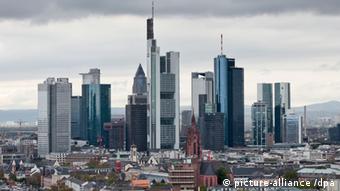
Frankfurt skyline Foto: Frank Rumpenhorst dpa/lhe
Frankfurt is a great place for foreign investors to earn tax-free interest
Germany protects the data of foreign investors, who also don't have to pay taxes on interest.
Only Germans, or foreigners resident in Germany, have to actually shell out a flat rate withholding tax on interest income, Meinzer said.
Information on such yields also rarely flows out of Germany, he added: "Foreign investors with German accounts are protected with a certain degree of anonymity."
That's why Germany ranks ninth in the world for financial secrecy, according to TJN.
Gibraltar
At the southern tip of the Iberian Peninsula, Gibraltar has specialized in allowing such letterbox companies, called "trusts." The structure of such trusts means there is no real owner of the company. They are often used to add a layer of secrecy to letterbox companies, Meinzer said, which is particularly good for money laundering.
Meinzer cited insider information in calling it "the dirty end of the spectrum" for bringing money back into financial markets. The presence of many gambling casinos there also comes into play.
Ireland
It's called the "double Irish" in the financial world: A company founds two subsidiaries in Ireland with its business tax rate of 12.5 percent. Then, one claims to be based in a different tax haven. (Comparable taxes in the United States, for example, are around 35 percent.)


This is completely legal in Ireland, and therefore an optimal location for companies such as Google, Apple or Amazon.While the one company does business in Europe, it pays the other patent fees. Profits vanish, as costs and income equal out on the balance sheet.
Although other countries like the Netherlands offer similar models, Meinzer said the difference is that people do actually work in Ireland, which at least creates some jobs and a bit of growth in the country.
Isle of Man
Taxes are kind of an afterthought on this island between England, Scotland and Ireland. Inheritances and capital gains aren't taxed at all, while the highest level of taxation lies at 20 percent. Corporate tax is nonexistent. It's especially loved as a hidey-hole for British millionaires.
Luxemburg
Luxembourg is the second-largest financial hub in Europe, after London. Innumerable investors and around 150 different banks enjoy a lenient tax framework in Europe's stocks and bonds center. Luxembourg's status as an EU member makes it particularly attractive for European companies and the international market, Meinzer explained. "If I want to get around German laws, for example, I could go through Luxembourg," Meinzer said, adding that 40 German banks do business there.


With its low tax rates, Malta, like Cyprus, has long drawn foreign capital. Although corporate taxes are around 35 percent, companies can get most of that refunded.
It's a favorite among German companies, which earn a higher profit if based on Malta. Meinzer said that while it's clearly a tax paradise for companies, it's not clear if that's also the case for individuals.
Monaco
The Principality of Monaco continues to be home to the rich and famous, being surrounded by France. Millionaires happily set themselves up there due to the fact that they pay no income or inheritance taxes. The city-state also does not prosecute financial crimes committed abroad. Businesses, however, must pay taxes there - at rates of around 33 percent. France, though it doesn't play an active role, lends a protective hand, Meinzer said.
Netherlands
What Luxembourg is for private investors, the Netherlands is for large corporations. Business taxes are incredibly low, with many tax advantages for interest and licensing income.
With the "Dutch sandwich," a parent company has a subsidiary in the Netherlands, which it uses as a cheap tax base to develop its European business.
Switzerland
Although there are supposedly no more completely anonymous bank accounts in Switzerland (and neighboring Liechtenstein), it continues to draw large sums of money due to its strict banking secrecy. Considering the volume of money in Switzerland, it made first place on the TJN's Financial Secrecy Index.
Full text in http://www.dw.de/